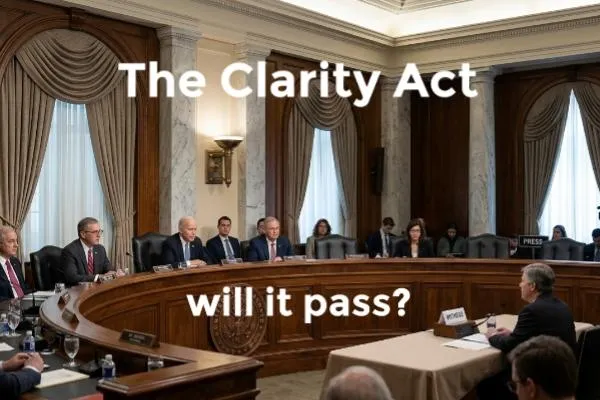
The Clarity Markup
Fellow Codger's and folks with an interest in the mechanics of how we are going to achieve Digital Asset Clarity, you have come to the right place! This blog is a bit longer than my usual missive and much more important. Know this, you will always receive the facts from me with no BS. The Clarity Act is not and will not be perfect. But it's a necessary start to codifying how the US is going to treat Digital Assets and it will ultimately affect each and every one of you.
The D.C. Chessboard: A Step-by-Step Guide to the May 14th Clarity Act Markup
The wait is finally over. This Thursday, May 14th, 2026, at 10:30 a.m. ET, the Senate Banking Committee will convene in Room 538 of the Dirksen Senate Office Building. This isn't just another hearing where politicians grandstand for the cameras; this is a Markup. In the world of an experienced observer, a markup is where the "sausage gets made." It is the decisive moment where the Digital Asset Market CLARITY Act—the most significant piece of crypto legislation in U.S. history—will either be polished for the Senate floor or left to gather dust in a committee drawer.
For those of us tracking Tokenomics and the long-term viability of the "Clean 16" digital commodities, this session is the "Super Bowl" of regulatory clarity. If this bill doesn't clear the committee before the Memorial Day recess, the legislative clock likely resets until 2030. Here is exactly what will happen step-by-step during this high-stakes executive session.
Step 1: The Gavel and the Opening Salvos
The session begins with Chairman Tim Scott (R-SC) calling the committee to order. As the primary architect of the Senate's version of the CLARITY Act, Scott will deliver an opening statement framing the bill as a matter of national security and economic competitiveness. Expect him to highlight how the lack of a framework has pushed innovation to Singapore and Abu Dhabi.
Immediately following, Ranking Member Elizabeth Warren (D-MA) will offer the counter-perspective. Her focus will likely remain on illicit finance and "investor protection," though the real battleground will be the Ethics Provision. This specific amendment seeks to bar senior government officials from profiting from digital assets—a direct shot across the bow of current administration-linked ventures.
Step 2: The Reading of the Bill (The "Chairman's Mark")
The "Mark" is the version of the bill the Chairman intends to move. While the House passed its version (H.R. 3633) back in July 2025, the Senate version has grown significantly. It now spans nine titles, covering:
SEC/CFTC Jurisdictional Lines: Drawing the "bright line" between what is a security and what is a commodity.
DeFi Protections: Ensuring that developers are not held liable for the "code" itself, but rather the "control" of centralized intermediaries.
Stablecoin Framework: The most contentious part of the entire package.
Step 3: The Stablecoin Yield Showdown
This is where the room will get hot. The Tillis-Alsobrooks Compromise is the centerpiece of the current negotiations. To break the deadlock, Senators Thom Tillis (R-NC) and Angela Alsobrooks (D-MD) proposed a "middle ground" regarding stablecoin rewards:
Passive Yield is Banned: You cannot earn interest just for "holding" a stablecoin, similar to a bank deposit.
Activity-Based Rewards are Permitted: You can earn rewards for using stablecoins in payments, transfers, or staking within a decentralized network.
The American Bankers Association (ABA) is currently in a "last-ditch" lobbying frenzy to kill this compromise. They argue that "activity-based" rewards are just a loophole that allows crypto to function as an interest-bearing deposit substitute. Watching which Senators side with the banking lobby versus the innovators will tell you exactly where the power lies.
Step 4: The Amendment Process (The "Meat")
After the opening statements, the floor opens for amendments. This is a rapid-fire sequence where committee members propose changes to the text. Each amendment is debated briefly and then voted on. Keep an eye out for these "Poison Pill" or "Pivot" amendments:
The Illicit Finance Hook: Look for attempts to expand "Know Your Customer" (KYC) requirements to unhosted wallets—a move that could cripple true DeFi.
The "Clean 16" Clarification: Some Senators may push for a more rigid list of assets that automatically qualify as digital commodities to provide immediate market certainty.
Bankruptcy Safeguards: Strengthening Title VII to ensure that if a centralized exchange fails, customer assets are legally segregated and cannot be used to pay off corporate creditors.
Step 5: The Final Roll Call
Once all amendments have been processed, Chairman Scott will move to "report the bill favorably" to the full Senate. This is the moment of truth.
A "Yes" Vote: The bill moves to the Senate floor for a full vote, likely in June or July.
A "No" or a Delay: If the committee deadlocks or the banking lobby successfully peels off enough Republicans, the bill is effectively dead for this session.
The SEC vs. CFTC: Who Wins What?
The CLARITY Act is essentially a peace treaty in the long-standing turf war between regulators. Here is the projected breakdown of the new landscape:
CategoryOversight BodyKey RequirementDigital CommoditiesCFTCMust be decentralized and "intrinsically linked" to a functioning blockchain.Investment ContractsSECPrimary market fundraising and tokens where a central party controls the roadmap.Payment StablecoinsJoint OversightSEC handles anti-fraud/manipulation; Federal Reserve/OCC handles prudential capital requirements.The "Clean 16"CFTC (Exempt)A specific list of tokens deemed fully decentralized and not subject to SEC disclosure rules.
Why the "Codger" is Watching This Closely
For those of us who have spent decades navigating the markets, we know that certainty is the ultimate currency. The CLARITY Act isn't just about crypto; it’s about the infrastructure of the next century.
If Title IX (DeFi Protections) survives the markup intact, it protects the "code-as-speech" principle that is vital for developers working on everything from Solana to the Internet Computer Protocol (ICP). By focusing on "control rather than code," the Senate is finally acknowledging that you cannot regulate an algorithm the same way you regulate a brokerage firm.
However, the banking lobby's resistance to the stablecoin yield compromise is a classic defensive play. They are protecting their "moat" of low-interest deposits. If the Senate caves to the ABA, we may see a version of the bill that technically provides "clarity" but practically stifles the utility of digital dollars.
Conclusion: The Path Forward
If you are copy-pasting this into your tracker, remember the date: May 14th. By the end of that day, we will know if the U.S. is ready to lead the "Clean 16" era or if we are going to let another four years pass in a state of regulation-by-enforcement.
The White House is reportedly targeting a July 4th signing. For that to happen, the Senate Banking Committee must act now. Stay tuned to the Corner—I’ll be watching the feed so you don't have to.
Quick Stats: The CLARITY Act Odds
Chances of clearing Committee: 85% (per recent legislative sentiment).
Chances of Senate Floor Passage: 75% (requires 60 votes to overcome the filibuster).
Major Obstacle: The ABA "Emergency Engagement" campaign.
The "Lummis Warning": If not passed by May 21st, wait until 2030.
Do you think the "activity-based" rewards compromise is a fair deal for the banks, or are they just trying to stop the inevitable?
