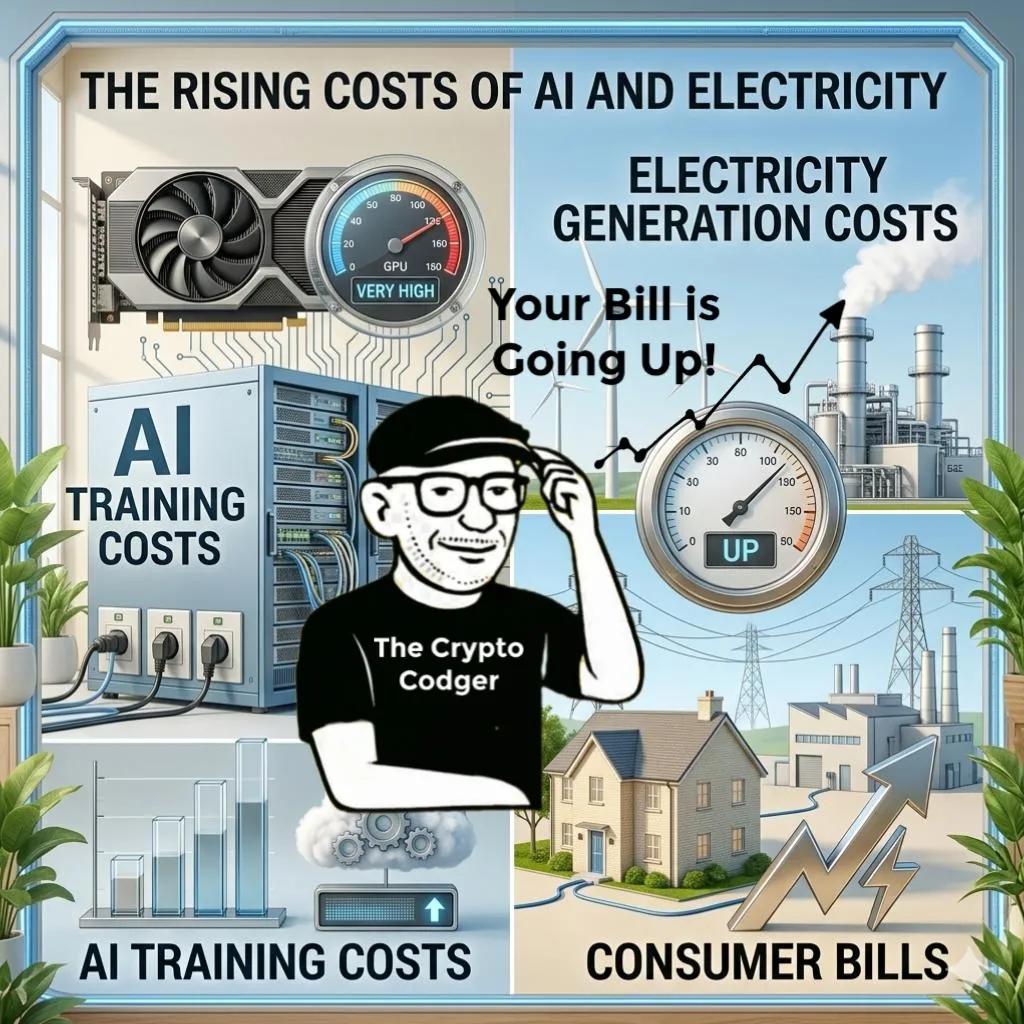
Electric Bill Shock
The Crypto Codger's Corner: The Electric Bill Shock Coming for the AI "Geniuses"
By The Crypto Codger | Tokenomics 101: Learn Crypto Without the Eye Rolls
Pull up a chair, folks. We need to talk about the electric bill.
If you’ve turned on the news lately, you’ve probably heard a whole lot of heavy breathing about the "AI Revolution" and how autonomous software is going to run our entire world. But as seasoned investors with 40 years of investment experience and a bit of financial scar tissue, we don't look at flashy software demos—the grown-ups in the room look at the plumbing. And right now, the plumbing is getting incredibly expensive.
The kids in Silicon Valley forgot one basic rule of the physical universe: Big brains take a lot of juice. The sheer explosion of artificial intelligence usage is colliding head-on with the cold, hard realities of our aging power grid.
Let’s look past the hype, bypass the tech-speak, and break down what this means for the future of computing, your pocketbook, and why the emerging "Agentic Economy" is going to have to pay up to play.
1. The Power Crunch: Modern Tech Meets an Old Grid
For years, tech companies tucked their data centers away in quiet corners, humming along on cheap, steady industrial power. But AI isn't your standard Google search. Training and running massive artificial intelligence models requires specialized, power-hungry servers that eat electricity like a traditional database never could.
The physical reality of this expansion is hitting a wall:
The Infrastructure Strain: Tech firms are planning massive data centers where single facilities aim to draw immense amounts of power.
Passing the Buck: Because utility companies have to spend billions on new generation capacity to feed these digital monsters, they are doing what regulated monopolies always do: passing the bill directly down to the consumer.
The Rate Hikes: Across the country, residential electric costs are ticking up. If you live near a major data center hub, public utility commissions are already adjusting rates, forcing regular residents to pay extra on their monthly home bills just to subsidize a local data center's power appetites.
We are running out of cheap juice, and a bipartisan backlash is brewing. Local town councils are finally demanding that tech companies foot the bill for their own exorbitant power usage instead of sticking it to regular folks.
2. The Cost of Compute Is Going One Way: Up
When the cost of your primary raw material—electricity—shoots up, the price of your finished product—compute—has to follow.
Right now, big tech companies are burning through billions in capital expenditures to build these state-of-the-art facilities. Up until now, tech companies have been heavily subsidizing the cost of AI for the public, giving away access for free or for a measly $20 a month just to hook users and gain market share.
But the days of the free lunch are drawing to a close. Between the cost of replacing short-lived server fleets and paying skyrocketing electricity rates, the business math just doesn't add up anymore. We are moving out of the "experimental software" phase and into the "industrial manufacturing" phase of AI. Compute is a physical commodity, and it's entering a structural bull market.
3. My Prediction: The End of the Cheap AI Subscription
If you think you'll be able to run premium, fully autonomous AI agents that handle your scheduling, your research, and your digital business for the price of a basic streaming subscription, think again. As data centers are forced to pay premium wholesale prices for electricity, they will pass those costs directly to the user.
🔮 The Codger’s Forecast
The era of the flat-rate, $20-a-month premium AI subscription will soon be dead for power users. Instead, we will see the rise of metered compute billing or highly stratified corporate packages. For a consumer or small business using advanced, autonomous AI agents daily, expect to see dedicated monthly AI utility bills ranging from $75 to $150 per user just to cover the cost of the underlying compute and power.
What’s a Codger to Do?
As conservative, common-sense investors, we don't panic when structural costs rise—we look for who owns the toll booths.
This energy reality is exactly why we stick to our core strategy: focusing on battle-tested, legitimate digital infrastructure rather than speculative junk. The text on the wall is clear. If the future "Agentic Economy" requires autonomous AI agents to execute millions of micro-transactions for machine-to-machine commerce, those agents are going to need efficient, trustless blockchain rails that can handle 25-cent micropayments without breaking a sweat or incurring massive banking fees.
But more importantly, those blockchain networks themselves will need to be highly optimized. The messy, inefficient networks will get absolutely eaten alive by underlying operational costs, while the premium, hardened, energy-efficient digital commodities—the ones we focus on in the Clean 16—will capture the market.
The tech world is learning a lesson that us old-timers have known for decades: infrastructure isn't free, and the house always gets its cut. Keep your head down, ignore the hype, use good old-fashioned risk management, and don't bet the farm on companies that don't know how to pay their power bills.
Until next time, keep it simple.
The Crypto Codger
Let's Talk in the Comments: What’s your take on the rising costs of technology? Are you noticing your local electric bills ticking up because of the tech boom, or are you looking into traditional energy sectors to balance out your portfolio? Pull up a chair and let me know!
