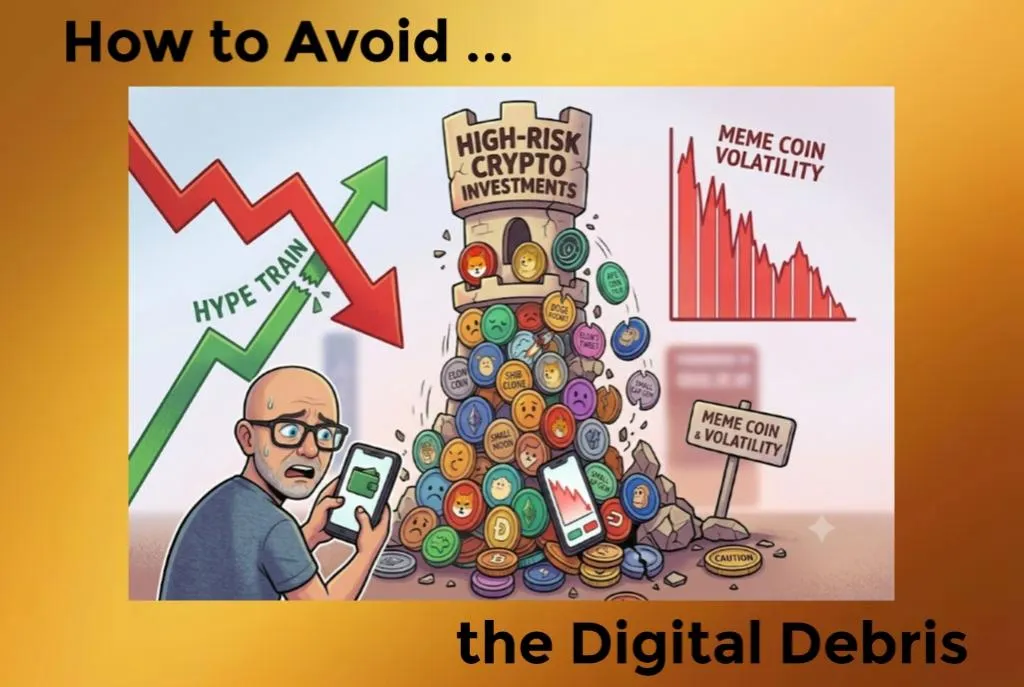
Avoiding Worthless Tokens
A Cautionary tale: The reality is Crypto has had a checkered past. That is precisely why I titled my new book "Crypto = Digital Assets". When ever possible I want to distance myself and my educational content from things that can be considered shady or criminal or even just poorly constructed with faulty logic. Fundamentally Crypto Tokens and Coins are Digital Assets. Pay attention to the following blog . . . it will save you time and money!
The Codger
The Crypto Codger’s Guide to Avoiding Worthless Tokens
Every crypto cycle produces the same sad little parade: shiny new tokens, loud influencers, wild promises, and gullible speculators convinced they’ve found the next Bitcoin. Most of them have not. Most have found a cleverly packaged pile of nonsense with a ticker symbol. By the time the hype fades, the promoters have moved on, and the late buyers are left holding digital compost.
The Problem With Altcoin and Memecoin Speculation
That’s the danger of altcoin and memecoin speculation. These are often tiny, thinly traded markets with weak fundamentals, little real adoption, and prices driven more by attention than value. A token can soar on rumors, social media noise, or coordinated buying, then collapse just as fast when the excitement dries up. People call that opportunity. I call it bait with a blockchain logo.
The Graveyard Is Already Full
Crypto history is littered with examples. BitConnect was touted like a wealth machine until it imploded in disgrace. Terra Luna and UST were presented as brilliant innovation until the whole structure detonated and vaporized billions. SafeMoon built a devoted following on hype and slogans, then delivered a brutal lesson in the difference between marketing and substance. Squid Game token turned pure frenzy into predictable ruin. And behind those better-known names lies a graveyard full of copycat meme tokens and low-cap “gems” that effectively went to zero and never came back.
Cheap Is Not the Same as Valuable
One of the dumbest habits in this market is confusing a low token price with value. A coin trading at fractions of a penny is not “cheap.” It may simply be worthless in smaller numbers. Real value comes from liquidity, developer activity, network usage, security, adoption, tokenomics, and whether the project solves a real problem. Bitcoin, Ethereum, and Solana are not perfect, but they operate on a scale that most speculative tokens can only dream about while they’re busy printing cartoon mascots and empty promises.
Day Trading Is a Fool’s Errand
And while we’re swatting bad ideas, let’s talk about day trading. Day trading crypto is a fantastic way for ordinary people to donate money to faster, smarter machines. You are not outmaneuvering firms and bots that process order flow, react to price changes, and execute trades in milliseconds. You, meanwhile, are sitting there with caffeine, conviction, and a phone screen. That is not an edge. That is a hostage situation. A few people get lucky for a while, then luck runs out and tuition gets paid to the market.
Why I Stick to the Clean 16
This is why I keep coming back to the Clean 16. The point is not to pretend risk disappears. The point is to avoid the junkyard. Stick with projects that have real ecosystems, meaningful liquidity, broad recognition, active development, and a credible reason to exist. That approach may not satisfy the fellow hunting 100x moonshots before lunch, but it gives you a far better chance of preserving capital and compounding gains without stepping on every rake in the yard.
The Codger’s Rule
If a token’s main selling points are “it’s early,” “it’s cheap,” “the community is strong,” or “it could do 100x,” you are probably not hearing an investment case. You are hearing a sales pitch aimed at greed. Serious investors need standards. They need patience. They need the discipline to ignore noise and stop dressing up gambling as strategy.
That’s the Codger’s rule: avoid worthless tokens, ignore memecoin hysteria, and stop pretending day trading is a profession for the average investor. Stick to quality. Stick to discipline. Stick to the Clean 16. In crypto, avoiding stupidity is usually more profitable than chasing genius.
Don’t confuse a pump with a project.
