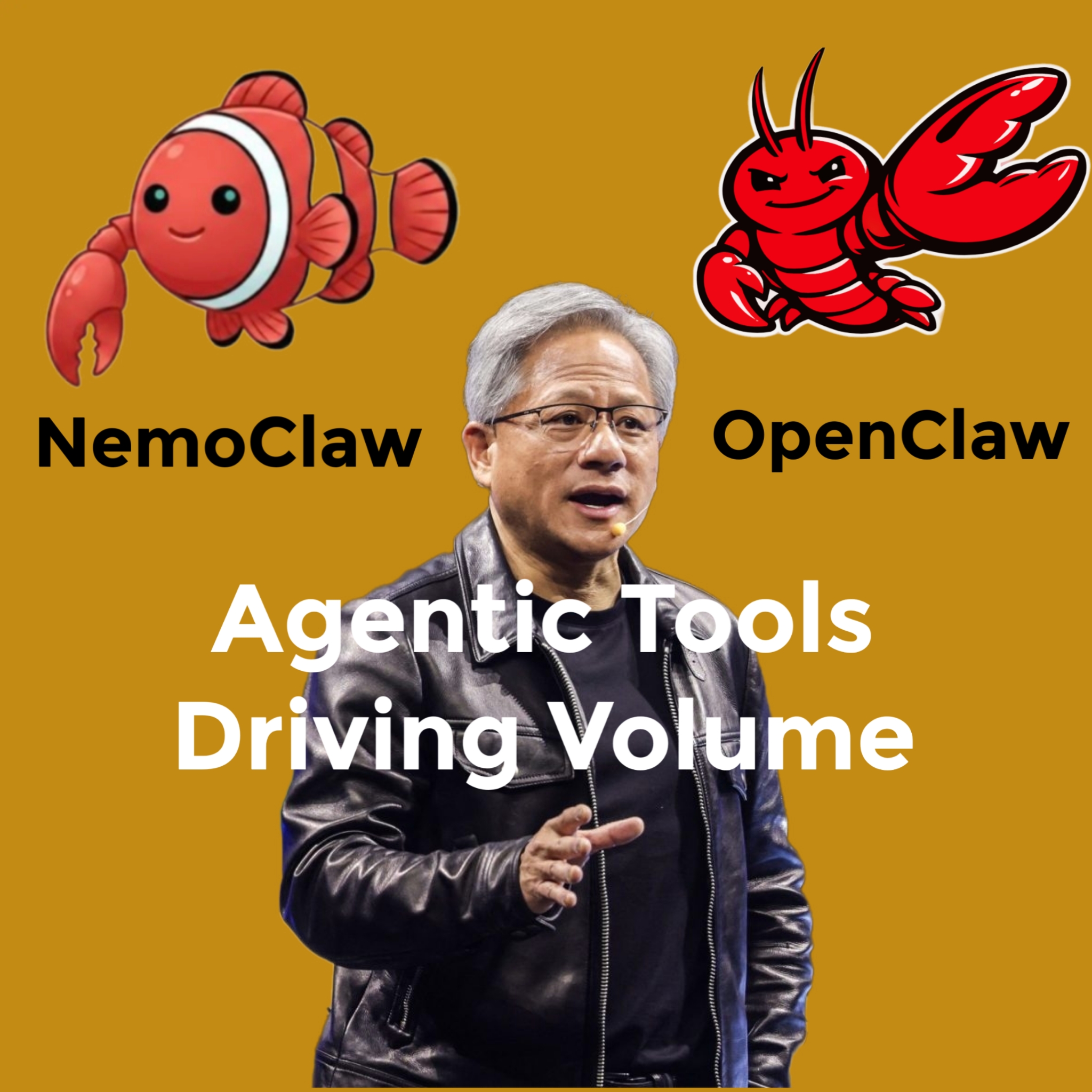
Open Claw will drive Token Volume
Why "Claws" are the Best News for Your Portfolio Since Bitcoin!
Listen up, because the world just changed again while most people were busy looking at memes. Last week, I sat through Jensen Huang’s GTC 2026 keynote—all two hours of it—and while the fancy graphics and talk of "Vera Rubin" chips are great for the gamers, there was a massive "aha!" moment for those of us holding digital assets.
If you’ve been wondering when crypto would move past pure speculation and into real, daily utility, Jensen just handed us the roadmap. He introduced OpenClaw and NemoClaw. It sounds like something out of a nature documentary, but in "Plain English," it’s the spark that’s about to set blockchain volume on fire.
What on Earth are OpenClaw and NemoClaw?
Let’s get the tech straight. Jensen called OpenClaw the "Operating System for Personal AI." Think back to the 90s. Before Windows, you had to be a computer whiz to do anything. Windows made the PC "user-friendly." OpenClaw does that for AI Agents. An agent isn't just a chatbot like ChatGPT that talks to you; it’s a "worker" that goes out and does things for you.
OpenClaw: This is the open-source brain. It allows anyone to create a "Claw" (an autonomous agent) that can manage your emails, trade your crypto, or even run a small business while you sleep.
NemoClaw: This is NVIDIA’s "Enterprise Security Guard." It’s the software stack that makes these agents safe for big companies. It adds the privacy and "guardrails" so a company’s AI worker doesn't accidentally leak the secret sauce to the public internet.
In short: OpenClaw makes the workers easy to build, and NemoClaw makes them safe to hire.
The Secret Ingredient: Why This Drives Crypto Volume
You might be asking, "That’s cool, Codger, but what does an AI worker have to do with my Ethereum tokens?"
Everything.
Here is the problem: AI agents don't have social security numbers. They can't walk into a Chase bank and open a checking account. If an AI agent needs to buy data, pay for a specialized service, or settle a trade, it needs a Digital Wallet.
When Jensen says every software company will become a "Token Factory," he isn't kidding. These millions of "Claws" will be the primary residents of the blockchain. Here’s how they create massive volume:
Micro-Payments: A human won't pay $0.001 to read a single weather report, but an AI agent will do it 10,000 times a day to calibrate a logistics route. Every one of those is a blockchain transaction.
Inference Budgets: To "think," these agents need to pay for computing power. This is increasingly being done on decentralized networks where tokens are the only currency accepted.
Coordination: If my "Claw" needs to hire your "Claw" to design a logo, they don't send a PayPal invoice. They execute a Smart Contract.
Ranking the Volume Drivers: Where the Action Is
Based on the GTC announcements and the early market reactions, here is where we expect the "Agentic Explosion" to hit the hardest in terms of transaction volume:
45% – Automated Trading & Prediction Markets: Agents are already the dominant players here. Protocols like Rain are now OpenClaw-ready, allowing agents to bet on outcomes and provide liquidity 24/7.
25% – Resource Provisioning (DePIN): Agents buying and selling storage, GPU power, and data. This is the "fuel" for the NemoClaw ecosystem.
15% – Inter-Agent Services: Agents "hiring" other agents for specialized tasks (coding, legal review, scheduling).
10% – Identity & Verification: Using the blockchain to prove that an agent is who it says it is and hasn't been "hacked."
5% – Governance & Voting: Agents managing DAOs (Decentralized Autonomous Organizations) for their owners.
The "Agentic" Multiplier: From Millions to Trillions
The real "kicker" from Jensen’s keynote was the sheer scale. We aren't talking about a few thousand bots. We are talking about millions of Agentic agents.
Imagine a world where every person has 10 "Claws" and every company has 10,000. These agents don't get tired. They don't take lunch breaks. They can execute transactions every single second.
When you have millions of agents making millions of micro-transactions, the on-chain volume doesn't just grow—it SCALES VERTICALLY. This stimulates digital asset prices in two main ways:
1. The Burning of "Gas"
Most blockchains require a native token to pay for transaction fees (Gas). As agents flood the networks with volume, the demand for this "Gas" sky-rockets. In many cases, a portion of this gas is "burned" (removed from supply), making the remaining tokens more scarce and valuable.
2. The Velocity of Money
In traditional economics, the more money "moves," the healthier the economy. Digital assets have suffered from being "static"—people just buy and hold (HODL). Agents change that. They keep the money moving, creating a high-velocity economy that attracts institutional liquidity.
Final Thoughts from the Codger's Corner
Jensen Huang didn't just announce a new way to run AI; he announced the End of the Speculation Era and the Beginning of the Utility Era.
For years, we’ve waited for a "killer app" for crypto. It turns out the killer app isn't a piece of software—it’s a digital worker. With OpenClaw making agents accessible and NemoClaw making them enterprise-ready, the floodgates for blockchain volume are officially open.
If you’re still sitting on the sidelines, just remember: The "Claws" are coming, and they don't use credit cards. They use crypto.
Stay savvy, stay invested, and don't let the tech jargon scare you away from one of the biggest opportunities in history.
