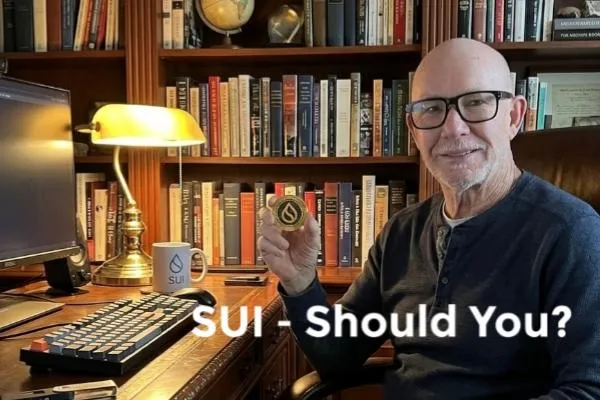
What's Beyond the Clean 16?
Why Stepping Outside the Clean 16 Requires Real Homework: A Look at SUI
If you've been around the block a few times, you know I’m a big believer in sticking to the "Clean 16"—the major, established digital assets that the regulatory bodies (like the SEC and CFTC) have effectively blessed as digital commodities. There is safety in those numbers. But occasionally, you have to look over the fence to see what’s being built in the neighboring yard. If you’re going to step outside that trusted circle, you can't just throw darts. You have to do the research, follow the infrastructure, and understand exactly what the technology is supposed to achieve.
Today, we’re looking at a project that has been making serious noise outside of that established circle: the Sui blockchain. I am not here to tell you to empty your bank account and buy the SUI token. I am here to break down the mechanics, the tokenomics, and the real-world adoption happening right now so you can understand why some very smart institutional money is taking this network seriously.
The Object-Centric Engine: Why SUI is Different
To understand why Sui is attracting developers, you have to understand how most older blockchains work. Imagine waiting in line at the DMV. Even if you just need a simple form stamped, you have to wait behind the person renewing a commercial license and the teenager taking their driving test. In a traditional blockchain, all transactions are processed sequentially in a massive ledger. If the network gets busy, everything slows down, and the fees go up.
Sui was built by former Meta (Facebook) engineers who decided to scrap that model. Instead, Sui uses an "object-centric" design. Think of it like a grocery store where every single item has its own dedicated express checkout lane. If you are buying an apple and I am buying a loaf of bread, we don't have to wait in the same line. Our transactions run completely parallel to one another. Because of this, Sui recently pushed its testnet limits to nearly 297,000 transactions per second. It is designed to be blindingly fast, and just as importantly, the fees are predictable and cheap—usually a fraction of a penny.
The Move Language: Prioritizing Security
Speed doesn’t mean much if the vault is left unlocked. We have all read the headlines about millions of dollars being drained from smart contracts due to coding errors. Sui tackles this by using a custom programming language called "Move."
Move was built specifically to handle digital assets securely. It prevents developers from making the common, rookie coding mistakes that lead to those catastrophic hacks. For developers building complex decentralized finance (DeFi) platforms or trying to tokenize real-world assets, that built-in security is a massive draw. It’s the digital equivalent of requiring all new homes to be built with fire-retardant materials.
The Tokenomics: Supply, Demand, and Deflation
Let’s talk money. The SUI token has a strictly fixed maximum supply of 10 billion tokens. It cannot be infinitely printed. However, it is vital to know that only about 3.5 billion of those tokens are currently circulating in the open market.
The remaining tokens are locked up and scheduled to be released gradually over the coming years to early investors and the development team. When these "unlocks" happen, new supply hits the market, which can occasionally suppress the price if demand doesn't rise to meet it.
But there is a counterbalance. SUI has built-in deflationary mechanics. When developers store complex data on the network, a portion of the SUI they pay is locked away in a "Storage Fund." Furthermore, a tiny fraction of tokens is burned (permanently destroyed) with every transaction. As network activity increases, more tokens are locked away or burned, actively shrinking the circulating supply.
Institutional Money is Paying Attention
A fast network with good tokenomics is just a science experiment unless real money shows up. And the money is showing up.
Sui recently surpassed $2 billion in Total Value Locked (TVL)—which is the amount of actual capital users have deposited into the network's financial applications. While that is still a fraction of what giants like Ethereum or Solana hold, it is a massive milestone for a newer network.
Furthermore, publicly traded companies are starting to hold SUI on their corporate balance sheets. For example, a specialized finance firm called Mill City Ventures (NASDAQ: MCVT) recently announced a $450 million private placement, aiming to direct nearly all of it toward purchasing SUI tokens as a treasury reserve. At the same time, major Wall Street asset managers like Bitwise have filed paperwork with the SEC to create a formal Sui ETF.
The Codger’s Takeaway
Stepping outside the Clean 16 is always a risk. You are moving from established blue-chip territory into the frontier. But if you are going to take that step, you want to look for networks that solve actual problems.
Sui isn't just another meme coin casino; it is an enterprise-grade payment rail built by some of the best engineers in Silicon Valley, designed to process transactions at speeds the traditional banking sector can only dream of. It has real-world adoption, massive liquidity, and growing institutional backing.
I'm old enough to remember when Sun Micro introduced Java Script to the fledgling internet in the early 1990's. The object oriented formatting of data sped up processes and help to create the internet as we know it today. The same object oriented concepts are at the heart of the SUI code. Will it be a breakthrough for blockchains? Some are betting on it.
Whether or not the SUI token belongs in your portfolio is a decision you have to make based on your own risk tolerance. But knowing what it is, how it works, and why Wall Street is suddenly paying attention? That’s just good homework.
Stay sharp, stay skeptical, and keep learning. — The Crypto Codger
