Securitize (SECZ)
Securitize, SPACs, and the Backdoor Route to Wall Street
If you've been watching the financial news lately, you might have noticed some heavy breathing about a digital asset company called Securitize debuting on the New York Stock Exchange under the ticker symbol SECZ. The talking heads love to throw around fancy banking vocabulary to make this stuff sound like rocket science, but after forty years of watching these cycles, I prefer to look straight at the underlying plumbing. It's kinda my thing . . . studying the plumbing I mean.
Let's break down exactly what happened, why they bypassed the traditional Wall Street parade for issuing a new security, and why this represents the global economic infrastructure being upgraded right under our feet.
The Game Plan: What on Earth is a SPAC?
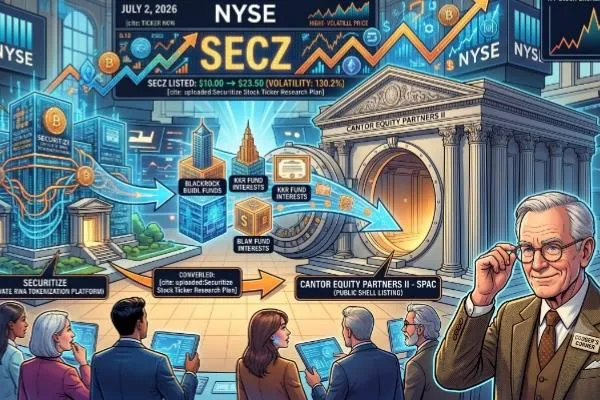
A bit of explanation is in order. Creating a SPAC and getting a company listed quickly has been around for a while. It's not always successful, and it's been used in many different industries. Securitize didn't make its public debut through a traditional Initial Public Offering (IPO). Instead, they went public by merging with a setup called a Special Purpose Acquisition Company (SPAC)—specifically, Cantor Equity Partners II.
If you ask an investment banker, they’ll give you a confusing lecture on reverse mergers. In plain English, think of a SPAC like a "blank check" shell company. It has no actual business operations, no factories, and no employees; it’s essentially just a giant corporate bucket filled with investor cash sitting on a stock exchange shelf.
The managers running the SPAC take that bucket of cash and go hunting for a quality, private operating business that wants to list its shares on the public market. When they find the right target, they snap the pieces together. The cash bucket pours straight into the operating company, and the operating business takes over the public listing through the backdoor, changing the ticker symbol to SECZ.
Bypassing the Traditional IPO Parade
Why would a serious digital asset firm choose a backdoor SPAC conversion over a traditional Wall Street IPO? It comes down to two classic rules: speed and operational certainty.
In a traditional IPO, an executive team has to go on a high-stakes corporate roadshow, traveling from city to city trying to convince institutional fund managers to buy their stock. It’s a massive, exhausting guessing game. Right up until the final night before the stock starts trading, the company doesn't actually know what price the bankers will give them. If market conditions suddenly sour at the last second, the whole parade gets rained out, and millions of dollars in underwriting fees go down the drain.
A SPAC flip removes that last minute gamble. The valuation of the company is negotiated and locked in months ahead of time between the operating company and the cash bucket sponsors. It strips out the Wall Street middleman, cuts the red tape, and gets the company listed significantly faster. For a high growth infrastructure firm, that means less time schmoozing bankers and more time building.
What Does Securitize Actually Do? (The Toll Booth Business)
Let's talk about the actual business under the hood of ticker SECZ. Securitize isn't trading synthetic fluff or speculative tokens named after cartoon animals. They own the regulated toll booths on the digital highway for Real World Asset (RWA) tokenization.
In plain terms, tokenization is just taking a traditional financial asset—like a block of real estate, a corporate bond, or a U.S. Treasury fund—and putting its ownership records onto a secure blockchain ledger. Instead of relying on slow, old-fashioned paper bookkeeping that takes days to settle, ownership is tracked instantly and securely.
Securitize is the infrastructure partner powering the heaviest hitters on Wall Street. When the multi-trillion-dollar asset manager BlackRock launched its BUIDL fund (a tokenized money market fund), they built it entirely on Securitize's rails. When massive institutions want to move their investment products onto public ledgers legally, they use Securitize because the company owns the transfer agent licenses, the broker-dealer approvals, and the regulated trading systems required by federal law.
The Real Upgrade: Trading 24/7/365
When Securitize hit the New York Stock Exchange, they did something unique. Alongside listing traditional common stock shares on the exchange floor, they tokenized a significant chunk of their own corporate equity natively on public blockchains like Solana and Avalanche.
Think about the implications of that plumbing. Traditional stock markets close at 4 PM on Friday and stay shut all weekend. But public blockchain networks never sleep. Because a portion of SECZ exists as a native token on-chain, it can be traded cleanly 24 hours a day, 7 days a week, with full shareholder rights and dividend entitlements. While the old-guard suits are away for the weekend, the digital ledger keeps settling transactions.
The options market cleared the stock for listing almost immediately, with active expirations stretching through late 2026. Because it's a newly listed company undergoing early public price discovery, the 30-day implied volatility is currently sitting at an elevated 130%. The rookies are panicking over short-term price swings, but a seasoned investor looks at the long-term pipeline.
The Bottom Line: Stock or Token?
Whether you hold SECZ as a traditional stock certificate in a standard brokerage account or as a digital token inside a secure vault, you own a piece of the mandatory highway of global commerce.
The business development path here is clear: as traditional finance systematically shifts its assets onto public ledgers to capture massive operational efficiencies, the transaction volume passing through Securitize’s engine will scale. They don't need to gamble on which individual cryptocurrency wins the race; they simply charge a fee on institutional vehicles passing through their toll booths.
My prediction is straightforward: do not get distracted by early high-volatility options noise. The long-term value of this security—whether you buy it as a stock share or a digital token—is fundamentally anchored to the structural replacement of global financial bookkeeping. As institutional de-risking continues, owning the core plumbing of the tokenized economy is as sensible as it gets. So here I am the retired Morgan Stanley Investment Advisor educating you about a security instead of a Coin or a Token. It's on the New York Stock Exchange with the symbol SECZ. Don't forget it!
Stay disciplined, keep your foundation simple, and leave the guessing games to the amateurs.
