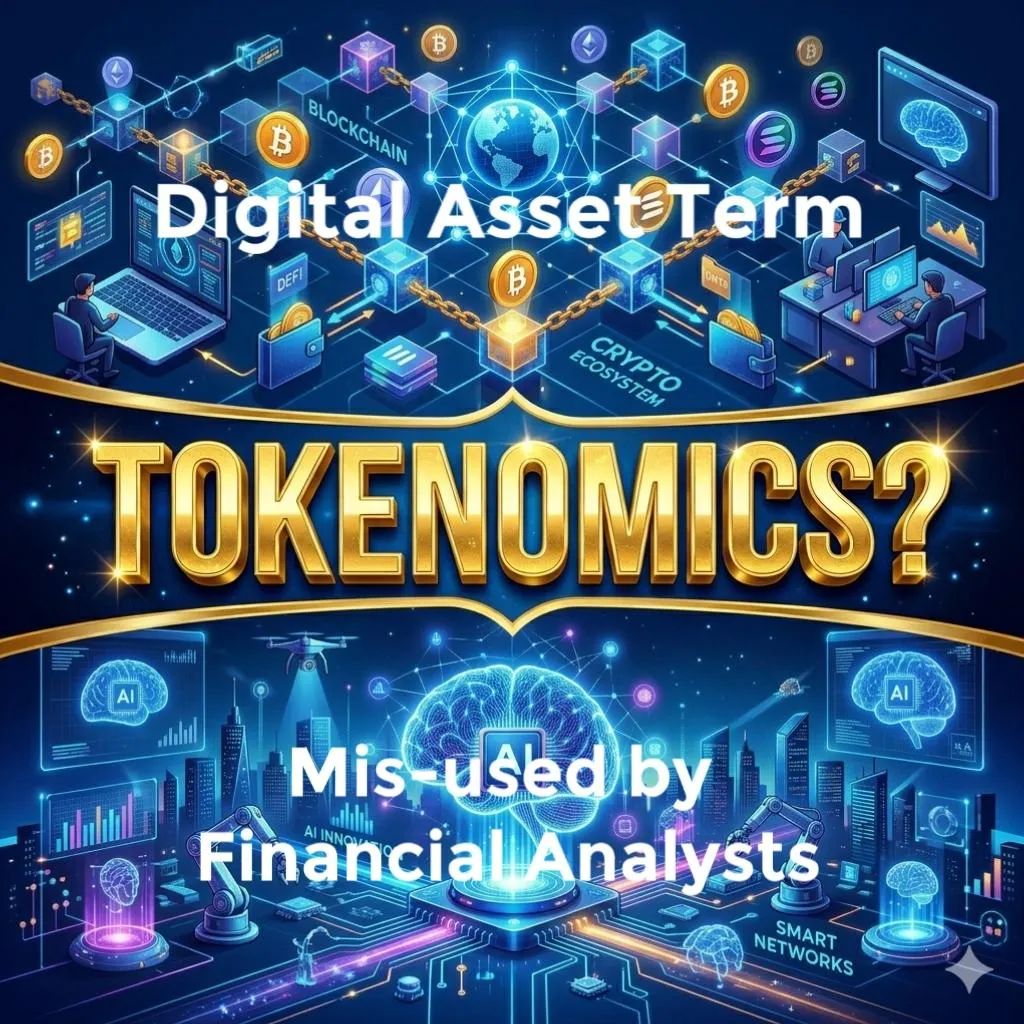
Tokenomics - Buzzword
The Tokenomics Buzzword Trap: Why Financial Media is Giving You the Wrong Map
Pull up a chair, folks. We need to talk about the vocabulary games being played on television.
If you’ve spent any time watching mainstream financial news networks lately, you’ve probably heard some suit-and-tie talking head use the word "Tokenomics" while discussing artificial intelligence companies, data centers, and computer server metrics.
If that confused you, it should have.
For anyone trying to navigate the markets with good old-fashioned common sense, listening to a financial analyst use a crypto term to describe an AI engineering problem is a recipe for an asset-losing headache. They are taking a very specific word, stretching it past its expiration date, and using it as a catchy buzzword.
Let's look past the mainstream media hype, check the actual structural plumbing, and get the definitions straight so nobody tricks you with fancy jargon.
The Root of the Confusion: One Word, Two Completely Different Fields
The entire reason financial news analysts are crossing the lines is because both cryptocurrency and artificial intelligence rely heavily on the word "token." But depending on which room you are standing in, that word means two entirely different things.
In the Crypto Space: A token is a digital asset, a coin, or a piece of infrastructure that lives on a blockchain (like Bitcoin or Ethereum). It represents transactional value or network ownership.
In the AI Space: A token has absolutely nothing to do with money or investing. In AI programming, a token is simply a tiny chunk of data—roughly four characters of text, or about three-quarters of a standard word—that a Large Language Model processes when you type a prompt.
Because both industries process "tokens," lazy analysts have started throwing the word "Tokenomics" around as a catch-all phrase for any business that involves tokens. But the economic realities of these two fields couldn't be further apart.
Phase 1: Real Tokenomics (The Crypto Definition)
When we talk about real, foundational Tokenomics (a literal mashup of Token and Economics), we are answering the core questions of digital asset valuation, market dynamics, and investor incentives.
True tokenomics is the blueprint that dictates whether a digital asset will earn long-term trust or just become more digital junk. When you look at an infrastructure play—like the assets on our "Clean 16" list—tokenomics evaluates three distinct pillars:
Supply Dynamics: Is there a hard-wired, predictable cap on how many coins can ever exist (like Bitcoin’s strict 21 million cap), or is the code designed to create inflation?
Distribution and Allocations: How much of the digital asset was kept by the founders and venture capitalists, and how much belongs to the public network? Aggressive token unlocks can dump unexpected supply into the market and tank a valuation.
Utility: Why does someone actually need to buy and hold this asset to use the underlying highway?
On this side of the fence, tokenomics is an economic framework that determines long-term capital valuation and investment risk.
Phase 2: AI "Tokenomics" (The Software Cost Structure)
Now, let's flip the ledger over to the artificial intelligence sector. When a Wall Street analyst looks at a corporate tech company and starts muttering about "AI tokenomics," they are completely misusing the word. What they actually mean is Operational Cost Structure and Usage Metrics.
They aren't talking about asset design or valuation dynamics. They are looking at the massive electricity, data center, and specialized computer microchip (GPU) bills that tech companies are racking up just to keep their AI systems running.
In the AI sector, evaluating "tokenomics" simply means measuring:
Input vs. Output Pricing: How much money an AI platform charges software developers per 1 million tokens (or chunks of text) processed. Input tokens (the text you type in) are cheap; output tokens (the sequential words the AI calculates to generate an answer) are incredibly resource-heavy and expensive.
Compute Infrastructure Costs: The physical cost of the energy grid capacity required to run millions of sequential text calculations every single second.
Profit Margins: Can these Silicon Valley start-ups charge customers enough fractions of a cent per word to out-earn the massive electricity bill coming from their data centers?
The Clean Map for Grown-Up Investors
To keep your strategy independent, disciplined, and grounded in common sense, use this simple rule of thumb the next time you turn on the news:
If an analyst tells you that a new crypto project has terrible tokenomics, they mean the economic design is flawed, the rules favor the insiders, and the coin is a bad long-term store of value.
But if that same analyst tells you an AI model has highly efficient tokenomics, don't go looking for a coin to buy. All they mean is that the software code uses less computer processing power, making it cheaper for the company to run.
The Bottom Line
Wall Street loves to use fancy vocabulary to make standard operational plumbing sound like advanced financial wizardry. Don't fall into the buzzword trap. Tune out the media clutter, look at the reality of the physical infrastructure, and keep your investment strategy simple and grounded.
Until next time, keep it simple.
— Ned T. Smith, The Crypto Codger thecryptocodger.com
