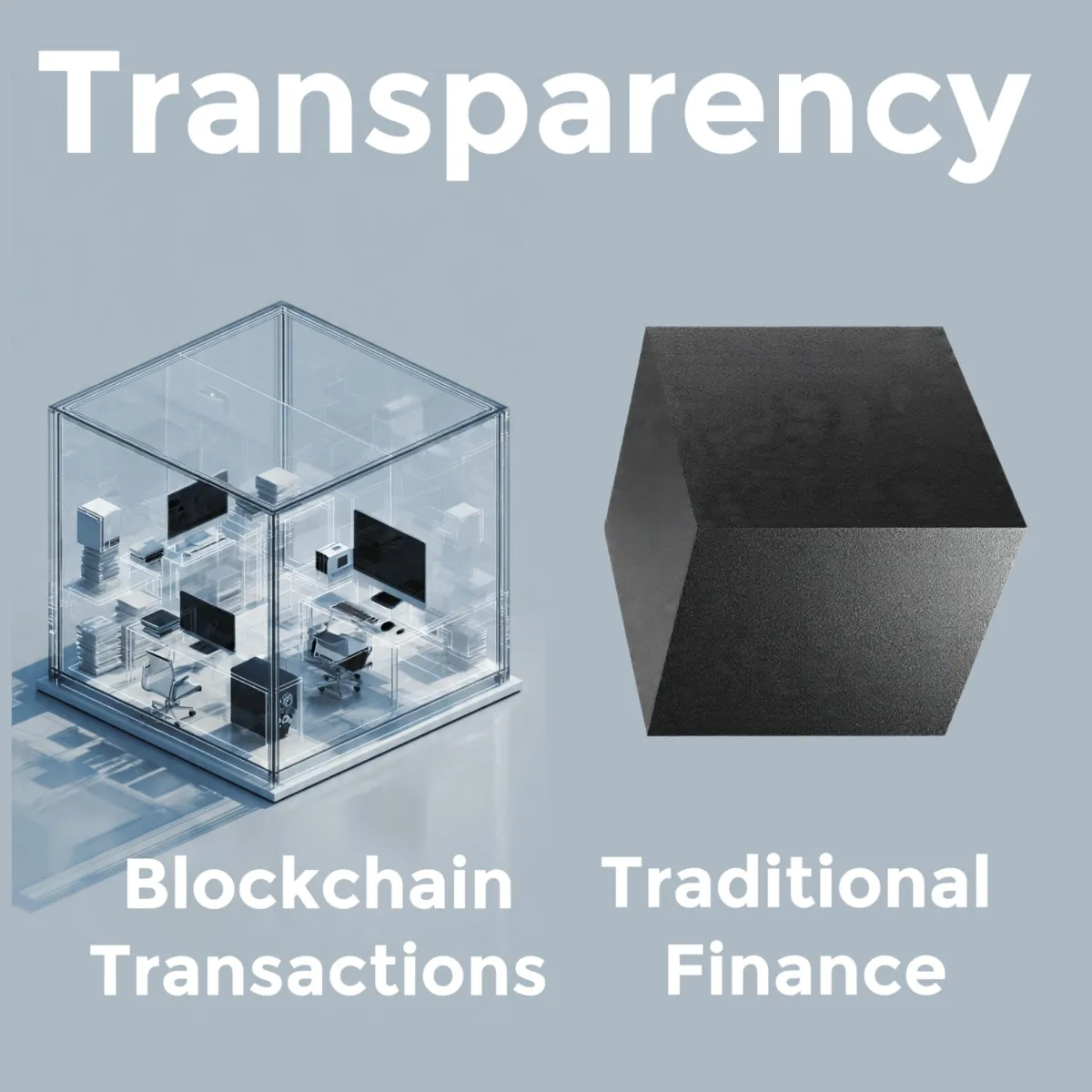
Glass House vs Black Box
The Glass House vs. The Black Box: Why I’ll Take Volatility Over Lies Any Day
By The Crypto Codger
Pull up a chair and listen close, because I’m only going to say this once before my afternoon nap. Some of you youngsters spend all day staring at those green and red candles on your phone, whining like a kicked dog every time the market dips five percent. You think the volatility is the problem. You think it’s "risky."
Well, I’ve spent forty years in the salt mines of traditional finance—from the mahogany desks of Bear Stearns to the corporate towers of Morgan Stanley—and let me tell you a secret: I’ll take a transparent roller coaster over a stable-looking lie every day of the week and twice on Sundays.
The difference between your "safe" traditional assets and Digital Assets comes down to one thing: Transparency. Or, as I like to call it, knowing whether or not the guy across the table has an ace up his sleeve or a hole in his pocket. Transparency is a first cousin to Trust!
The Traditional "Black Box" (The 'Trust Me, Son' Model)
Back when I was a young broker, we didn't talk about transparency. We talked about "proprietary data." That’s just a fancy way of saying we knew things you didn't.
In the traditional financial world, you’re playing a game in a dark room. You hand your money to a big bank, they give you an IOU, and then your assets disappear into a "black box" of clearinghouses and private ledgers. You want to see where your money actually is? Good luck. You have to wait for a quarterly statement to arrive in the mail, and even then, you’re looking at a snapshot of the past, not the reality of the present.
When a massive hedge fund decides to dump its position in a stock, do you see it happening? Nope. They hide their trades in "dark pools" so they don't spook the market. By the time you find out they’ve exited, the price has already dropped, and you’re the one left holding the bag.
The traditional system is built on opacity. They claim it’s for "stability," but I call it a "curtain of ignorance." It’s stable right up until it isn’t—remember 2008? Everything looked fine on the books until we realized the vaults were stuffed with toxic subprime garbage. We couldn't see the rot because the ledgers were private.
The Digital "Glass House" (The Universal Ledger)
Now, look at the blockchain. It’s the exact opposite. It’s a financial system built inside a glass house.
When you hold Bitcoin or Ethereum, you aren't trusting a guy in a tailored suit at a bank. You’re trusting a public ledger that every single person with an internet connection can audit 24/7.
In the crypto world, there are no "dark pools." If a "whale" moves a thousand BTC to an exchange, a little alarm bell goes off on the internet instantly. We all see it. We see the flow of funds. we see the liquidations. We see the collateral.
It’s Universal Transparency. It’s the first time in human history where the "little guy" has the exact same information at the exact same time as the billionaire in the penthouse.
Why the Truth Makes the Market Jump
Now, here’s where you kids get confused. You ask me, "Codger, if everyone can see everything, why is the price so jumpy?"
Listen to me: The volatility is the direct result of the transparency.
In the stock market, bad news is filtered, massaged by PR firms, and leaked slowly to the press. The market reacts like a slow-turning ship because the information is drip-fed.
In Digital Assets, everyone sees the fire at the same time. When a major protocol has a bug or a big holder starts selling, the entire world reacts in a millisecond. There’s no "circuit breaker" to stop the trading. There’s no "Market Close" at 4:00 PM to let everyone calm down. It’s raw, unfiltered reality hitting the price chart all at once.
The volatility isn't a "bug"—it’s the market digesting the truth in real-time. It’s messy, it’s loud, and it’ll make your stomach do flip-flops. But it’s honest.
The Codger’s Bottom Line: Why Transparency is the Reason to Hold
So why would an old, cranky financial advisor like me tell you to hold these volatile assets?
Because I’m tired of being lied to!
In the traditional world, "stability" is often just a mask for hidden leverage and backroom deals. In the digital world, the risk is right there in front of your face. You can see the math. You can verify the supply. You can track the movement.
I’d rather ride a bucking bronco that I can see, than sit on a "stable" bench that’s secretly being eaten by termites.
The suit-and-tie crowd hates the blockchain because they can’t hide their moves anymore. They can’t front-run you as easily. They can’t print more "shares" out of thin air when the public ledger says there are only 21 million units.
Stop whining about the 10% drops. That’s just the price of truth. If you want "safe" and "private," go bury your gold in the backyard. But if you want to be part of the first truly honest financial system we’ve ever had, stay the course.
Now, get off my lawn and go check the block explorer. The truth is out there for everyone to see—if you’ve got the stomach for it.
