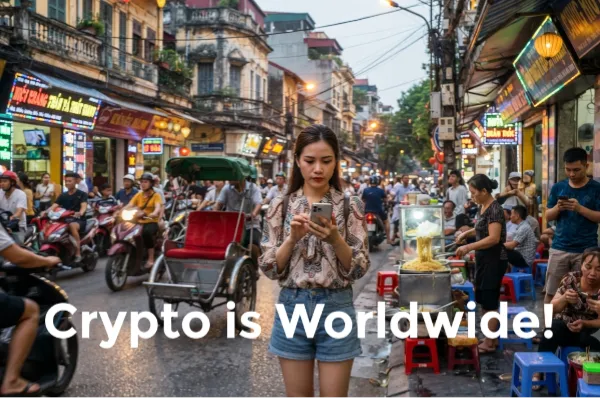
Digital Assets Grow Worldwide
Beyond Wall Street – Why the Digital Asset Boom is Happening Around The World
By Ned - The Crypto Codger
If you listen to the nightly news or read the financial columns published in New York and London, you would think digital assets are exclusively a Western playground dominated by Wall Street exchange-traded funds and corporate treasuries. You'd imagine boardroom arguments over securities law and Bitcoin's price action against the S&P 500.
But if you lift your gaze past the domestic headlines, a much larger, more profound story is unfolding across the globe. Digital assets are not just an American phenomenon. Across developing nations in Latin America, Southeast Asia, and Sub-Saharan Africa, digital infrastructure is quietly becoming the primary financial lifeline for hundreds of millions of everyday people. While domestic investors argue over regulatory bills and short-term price swings, a massive grassroots migration is taking place in economies where traditional banking systems have failed the working class.
Let's look past the noise and examine the physical plumbing of how global adoption is driving the next era of digital asset utility.
The Mobile Phone Blueprint: Bypassing the Bank Branch
To understand how fast digital finance is expanding in developing regions, we only have to look at the recent history of telecommunications. Just as mobile phones completely bypassed the need to string physical copper telephone wires across jungles, mountains, and rural villages, smartphones and digital wallets are bypassing the need to build expensive brick-and-mortar bank branches.
Over half of the global population (58% according to estimates) now owns a smartphone, and mobile money platforms have exploded across emerging markets. In places where local paper currency is rapidly losing value to severe inflation, everyday citizens are not waiting for central banks to fix the problem. They are opening digital wallets on their phones to protect their hard-earned savings.
Data tracking firms measure this grassroots shift using Purchasing Power Parity, a weighted on chain value, meaning they look at the real economic weight of digital transactions adjusted for local costs of living. By this metric, developing nations consistently lead the world in actual, functional usage. When a teacher in Argentina or a small shop owner in Nigeria trades unstable local currency for digital dollars to preserve their purchasing power, they are utilizing the network for sheer economic survival.
A Specific Case Study: Remittances in the Philippines
Here is a concrete example an American might not immediately consider. Let's look at the Philippines. Millions of Filipinos work overseas—in the Middle East, Europe, and North America—and send money back home to support their families. This is called a remittance payment.
Historically, sending this money involved using services like Western Union or traditional banks. The process was slow (often taking days), expensive (with fees sometimes exceeding 10% when currency exchange rates were factored in), and required the recipient in a remote Philippine province to travel to a physical agent location, wait in line, and present identification to collect cash.
Today, many of these families are bypassing that entire archaic system. The overseas worker purchases digital currency (usually a stablecoin pegged to the U.S. Dollar, like USDC or USDT) on a global exchange and sends it directly to a digital wallet on their relative's smartphone in the Philippines.
The transaction takes seconds, costs pennies in network fees, and arrives directly on the recipient's phone. The recipient can then use that digital value to pay for groceries at local merchants who accept crypto, or they can walk to a local "crypto-remittance" agent—often just a local neighborhood shop—and instantly convert that digital value into Philippine Pesos, without the high fees and long waits of the traditional banking system.
This is not about speculation. It is about an overseas worker making sure their family can eat dinner that night without losing 15% of the value to middlemen.
From Local Survival to Global Wallet Volume
Why does this grassroots adoption matter to someone watching the broader digital asset economy? It comes down to simple supply and demand mechanics embedded within the network plumbing.
When millions of new users across emerging markets adopt digital wallets for everyday savings, local commerce, and cross border family support payments, they generate a continuous stream of transaction volume. Every time a transfer occurs across a public blockchain, small network fees are processed, and native utility assets are utilized to clear the transaction.
Think of public blockchains as digital toll roads or global utility grids. When billions of micro-transactions flow through these digital highways every single day, it creates persistent, structural demand for the underlying infrastructure tokens. When available market supplies are locked up or continuously burned to pay for network computing power, steady economic utility paired with tight supply dynamics drives long-term asset appreciation. The value isn't being pumped up by speculative retail hype; it is being anchored by real, indispensable global utility.
What Grown-Up Investors Should Watch
As seasoned investors, our job isn't to chase speculative internet fads or get caught up in local political arguments. Our job is to look at where the structural capital is flowing and understand the physical reality of the pipes.
The developing world's adoption of digital wallets proves that blockchain technology has graduated from a speculative hobby into essential global infrastructure. As cell phone penetration deepens and billions of unbanked citizens plug directly into digital ledgers, the baseline volume moving through these networks will only accelerate.
Keep your head down, ignore the mainstream media clutter, and focus on the architecture. Progress is inevitable, and the plumbing doesn't lie.
Ready to learn how to navigate the modern digital economy with common sense and discipline? Secure your financial foundation today. Pick up a copy of my book,Crypto = Digital Assets, available now on Amazon Kindle, and learn how to protect and grow your wealth using the next generation of financial infrastructure.
