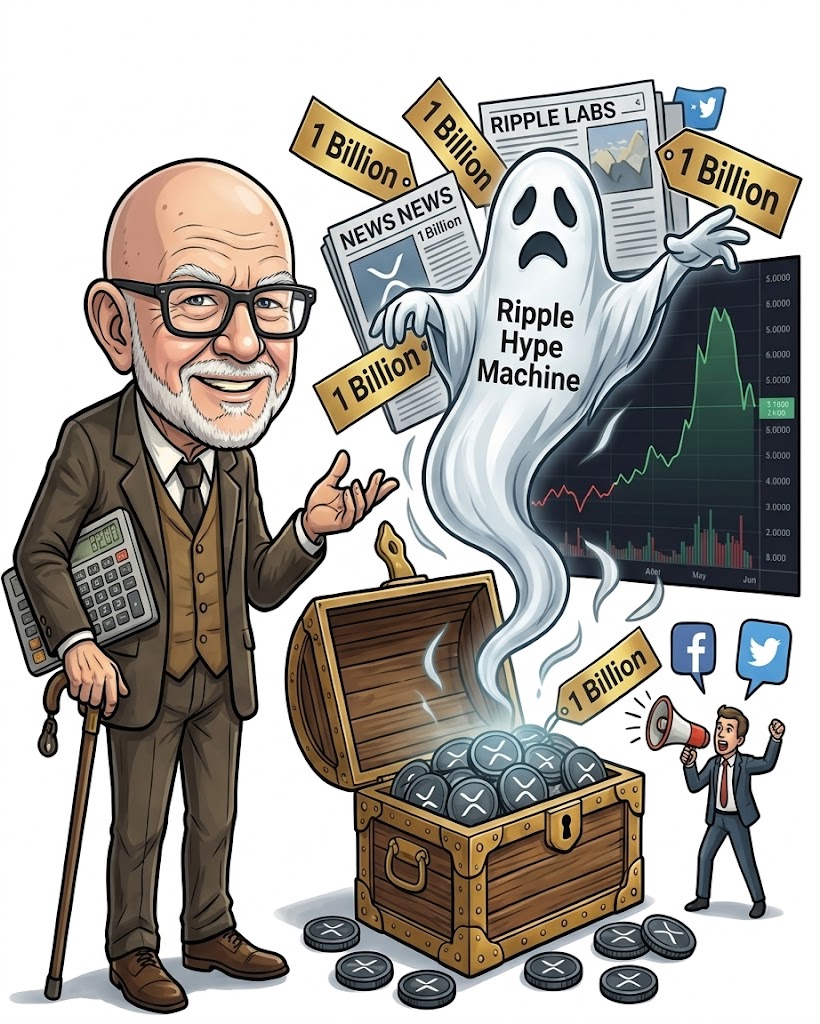
XRP - Monthly Hype?
XRP’s Monthly Magic Trick: Escrow, Hype, and the Manipulation Question
I will probably get a lot of flack from the XRP army, but here goes. As the Codger I’m cantankerous by nature, and there is plenty of controversy around the XRP universe, so here is my take on it all.
Brief History
Ripple originally created 100 Billion XRP tokens. 20% went to the Founders and the rest to what is now Ripple Labs. There are currently around 35 Billion Tokens in an escrow account with a monthly release schedule of 1 Billion a month.
Most months 200-300 Million of the release is purchased and the rest goes back into escrow. Ripple Labs uses that to fund their operation.
Every month, Ripple’s XRP escrow program rolls back into view like a traveling medicine show: one billion XRP comes out, headlines erupt, social media starts hollering, and the public is told—again—that this is all perfectly ordinary. Maybe it is. But when a company depends on XRP-related cash flow and the hype machine reliably revs up around those release windows, scrutiny is not paranoia. It is common sense.
Ripple’s escrow structure was created to make supply more predictable by locking large amounts of XRP into time-based releases, usually on the first day of each month. Public reporting this year has continued to describe that pattern, along with the familiar follow-up claim that Ripple typically re-locks most of the released XRP rather than dumping the full amount into the market. That is the company’s strongest defense: the program is transparent in design, the calendar is known in advance, and the net supply impact is often smaller than the scary headline suggests.
Fine. But transparency of schedule is not the same thing as innocence of motive. Ripple has long had an obvious economic incentive to maintain favorable XRP sentiment because XRP sales have helped finance operations, and the SEC’s 2020 complaint explicitly alleged that Ripple and two executives raised money through XRP sales to fund the business. That does not prove manipulation. It does mean nobody should pretend there is no motive to care about price support, market mood, or the timing of investor enthusiasm.
The Swamp Fog
This is where the swamp fog rolls in. Around those release windows, the internet fills with absurd XRP price predictions, dramatic “supply shock” narratives, and content that sounds less like analysis and more like a carnival barker with a blockchain wallet.
If you are on Social Media you have seen the hype: “Will XRP be $1000 by the end of the Year” etc etc. Some of the noise clearly comes from:
Click-hungry crypto sites
Affiliate marketers
Recycled AI sludge
Social-media grifters
That ecosystem exists whether Ripple has anything to do with it or not.
A Responsible Investigation
And that distinction matters. There is a responsible way to describe the problem and an irresponsible way.
The irresponsible way: To declare, without evidence, that Ripple Labs or its executives are secretly directing the bot armies and the prediction mills.
The responsible way: To say this: Ripple’s business incentives are obvious, the monthly release calendar creates repeated moments where hype can matter, and the timing of promotional content deserves investigation.
That is a serious argument because it is testable. If hype content repeatedly clusters in the days before monthly unlocks—across websites and other channels—then that pattern can be measured. If the same domains, same phrases, same article structures, and same amplification accounts show up month after month right before escrow events, then the case for coordinated sentiment management gets stronger. Stronger, but not proven.
What has not been shown in public, at least not yet, is the hard link between Ripple executives and the operators of the hype network. David Schwartz has publicly pushed back on the grand-conspiracy version of the story, saying NDAs do not prove hidden XRP plans and warning people against investing based on fantasies of secret arrangements. He may be right. NDAs are common in business, and suspicion alone is not evidence.
The Smell Test
Still, the smell test matters. When a company has predictable monthly token releases, a known interest in orderly market conditions, and a surrounding internet culture that erupts with conveniently timed hopium, scrutiny is not defamation—it is due diligence.
The key is to avoid leaping from “this looks coordinated” to “these specific executives ran it” unless there is documentary proof, payment trails, agency overlap, or direct communication tying them to the campaign.
The Crypto Codger Verdict: The XRP escrow program is not automatically proof of manipulation, but it creates the exact kind of incentive structure that deserves relentless, skeptical observation. The hype ecosystem around XRP is real, the timing question is legitimate, and the burden is on investigators to separate grifters, true believers, and any possible insiders without turning conjecture into slander.
In markets, as in old age, the first rule is simple: when someone insists the whole thing is perfectly normal, check where the money is going.
