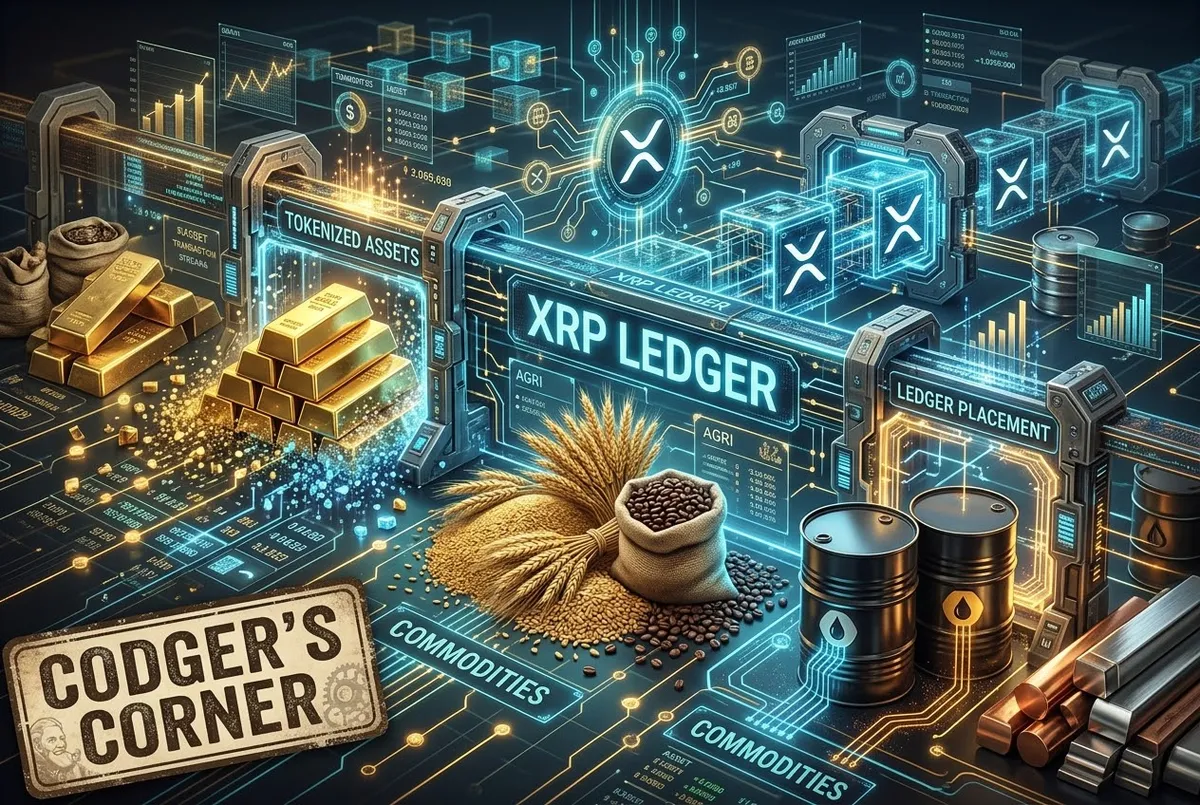
XRP and Commodities
Why $2 Billion in Commodities Just Landed on the XRP Ledger
By The Crypto Codger
If you have spent even five minutes reading crypto headlines lately, you know the circus is in full swing. Speculators are screaming on social media, day traders are chasing dog-themed tokens, and everyone is trying to get rich by lunchtime.
Meanwhile, behind the noise, something quiet and monumental just happened in the grown-up corner of the financial world.
According to recent blockchain market analytics, institutional financial desks quietly moved $2.2 billion worth of real-world commodities onto the XRP Ledger (XRPL). In fact, the XRP Ledger officially surpassed Ethereum in year-to-date growth for tokenized physical commodities.
Now, if terms like "tokenization" make your eyes glaze over, take a breath. I spent over forty years in traditional finance before I started digging into blockchain, and I can tell you this: you don't need a degree in computer science to understand what is happening here. You just need some good old-fashioned common sense.
Let’s break down what this actually means, why it matters, and how it lays the tracks for something much bigger.
The Digital Warehouse Receipt
Back when I was advising clients on physical asset holdings, nobody who bought gold or crude oil had 50-pound bullion bars delivered to their doorstep.
Instead, a secure, audited depository—like Brinks or a custodial trust bank—locked the physical metal inside a vault. They handed you a legally binding piece of paper called a warehouse receipt proving you owned it. If you wanted to sell that gold, you endorsed the paper receipt over to the buyer.
"Tokenization" is nothing more than taking that paper warehouse receipt and turning it into a cryptographic digital certificate on a blockchain ledger.
One digital token equals one physical troy ounce of gold or one barrel of crude sitting in a verified vault. When you buy or sell that token, legal ownership transfers in about three seconds, settled directly across the ledger without requiring clearinghouses, bank wire delays, or stacks of courier paperwork.
Why Ethereum Got Benched for the Heavy Lifting
For years, Silicon Valley technologists claimed Ethereum would be the king of all digital finance because of "smart contracts." But when Wall Street and commodity trading desks started looking at the actual logistics, they ran into a wall.
Think of Ethereum like a crowded, eight-lane toll turnpike at rush hour. You have got sports cars, delivery vans, and teenagers on electric scooters all fighting for the same asphalt. When traffic spikes, the tollbooth fee (what crypto folks call a "gas fee") jumps wildly from $2 to $50 or more just to pass through.
If you are an agricultural firm or an oil trader settling millions of dollars in commodity contracts each week, you cannot run a business on surge pricing. You cannot tell your chief financial officer that today's settlement costs fifty times more than yesterday's just because an online trading craze jammed the highway.
The XRP Ledger, on the other hand, was never built to host video games or speculative cartoon pictures. It was engineered from day one to be an industrial freight railway:
Tiny, fixed overhead: Moving an asset costs a fraction of a single penny.
Predictable schedule: Transactions settle in 3 to 5 seconds flat.
Native machinery: The trading engine and order books are built right into the core steel of the ledger, not bolted on with complicated, hack-prone third-party software.
When institutions have real freight to move, they skip the toll road and load the cargo onto the railroad.
How Commodity Freight Powers the XRP Token Engine
Now let's connect the dots to the native XRP token. How does moving gold and oil on the ledger actually support the value of XRP itself?
It boils down to three mechanical gears:
The Postage Stamp That Gets Burned: Every time a commodity token is transferred or traded, the network requires a transaction fee paid in XRP. But unlike traditional networks where fees go into a middleman's pocket, on the XRP Ledger that fee is permanently destroyed. It is like a postage stamp that gets incinerated the instant the letter is delivered. Billions in commodity transactions burn through XRP supply day and night.
The Security Deposit: You cannot do business on the rail line without putting skin in the game. Every account that holds a tokenized commodity must lock up a mandatory reserve of real XRP. When thousands of institutional clients open accounts to hold tokenized gold, millions of XRP tokens are pulled out of circulating supply and locked away as operational working capital.
The Universal Currency Bridge: The ledger has an automatic feature called Auto-Bridging. If someone wants to trade tokenized gold for tokenized copper, the system automatically checks if routing through XRP offers a tighter spread and a cheaper trade. As the volume of tokenized goods expands, XRP becomes the high-speed settlement bridge connecting them all.
But Hold On A Second...
I know what you are thinking. In fact, I can already hear the skeptical codgers in the back row clearing their throats:
"Hold on a minute, Codger! If billions in real-world freight are rolling onto the ledger, why hasn't the price of the XRP token already skyrocketed? What about that massive monthly escrow account dumping hundreds of millions of tokens onto the market every thirty days?"
That, my friends, is the multi-billion-dollar elephant in the room. And it is a completely fair question.
In Part 2 of this series, we are going to open that vault, look at the cold, hard math of Ripple’s monthly escrow, and map out the exact economic tipping point where that supply overhang stops holding XRP back—and starts becoming the very liquidity institutions need.
Stay tuned.
