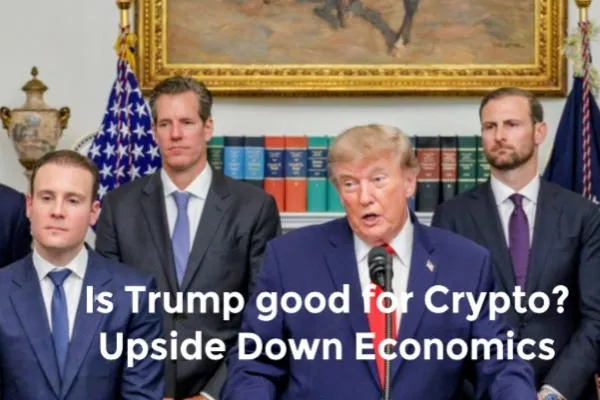
Upside Down Economics
The Upside-Down Economics of Cheaper Money
By Ned -The Crypto Codger
If you have spent five minutes listening to Donald Trump talk about the Federal Reserve over the years, you have probably noticed a recurring theme: no matter what the economy is doing, the answer is always lower interest rates.
In fact, he has publicly insisted repeatedly that whenever the economy is booming and putting up great numbers, interest rates ought to plummet right along with it.
To anyone who has ever taken a basic economics class, operated a household budget, or lived through a full market cycle, this logic is head-spinning. It turns decades of basic monetary science completely upside down.
The Gas Pedal and the Brakes: Economics 101
To understand why this idea is so backward, think of the United States economy like driving a heavy automobile:
Lowering interest rates is stepping on the gas pedal. It makes borrowing money cheap and easy. Businesses take out loans to expand, consumers use cheap credit to buy cars and houses, and cash floods into the marketplace. You do this when the car is sputtering uphill or stalling out—meaning the economy is weak and needs a boost.
Raising interest rates is tapping the brakes. When the engine starts running too hot and everyone is spending so fast that prices begin skyrocketing out of control (inflation), borrowing money is intentionally made more expensive. This slows down reckless borrowing, cools down demand, and keeps the car from crashing into a wall.
Now imagine driving that car down a steep hill at ninety miles an hour with the engine roaring.
Trump’s economic advice? "Look at how great this car is moving! Let’s stomp the gas pedal through the floorboards!"
In the real world, cutting interest rates to zero during a strong economy does not reward success; it throws gasoline directly onto the fire of inflation. It erodes the purchasing power of every working person’s paycheck and punishes savers who just want a decent return on their bank deposits. The only people who benefit from perpetually free money are real estate developers and chronic borrowers who rely on continuous debt refinancing to keep their financial houses of cards standing.
The Silver Lining: Why I Still Welcome His Digital Asset Stance
Given that his grasp of interest rates runs in reverse, you might wonder why I—or any seasoned investor—would appreciate his vocal endorsement of digital assets and modern blockchain technology.
The answer is simple: You do not need an ally to understand how the engine works in order to appreciate that they are opening the toll gate.
Here is the rationalization:
A Bulldozer Against Bureaucracy: For years, American innovation in digital assets was strangled by confusing regulations and hostile enforcement. Regardless of his deeper economic theories, Trump’s political backing acted like a battering ram against regulatory gridlock. It cleared the runway for clear rules, institutional custody, and the official recognition of digital commodities.
Right Destination, Accidental Map: Sometimes politicians champion the right tools for completely self-serving or simplified reasons. A politician might back digital assets because they like the headlines, the campaign support, or the optics of being modern and disruptive. But once legitimate frameworks are established, the permanent infrastructure benefits the entire country.
The Ultimate Insurance Policy Against Bad Policy: Ironically, the very financial ignorance that demands constant money-printing and artificially low rates is the exact reason digital assets need to exist in the first place. When political leaders treat interest rates like a popularity contest rather than an economic stabilizer, they weaken paper currency. Fixed-supply digital assets provide an essential, rules-based alternative that no politician can artificially inflate.
The Takeaway
We can call a spade a spade. Urging the central bank to cut interest rates into the floor during economic expansion is financially reckless and fundamentally uninformed.
However, in the world of investing, you separate political noise from structural progress. We can laugh at backwards economic theories while simultaneously taking full advantage of the regulatory doors being pushed open for modern digital finance.
Enjoy the progress, keep your eyes on the real mechanics of the market, and never mistake political rhetoric for sound financial advice.
Until next time, keep it simple.
Ned T. Smith, The Crypto Codger
