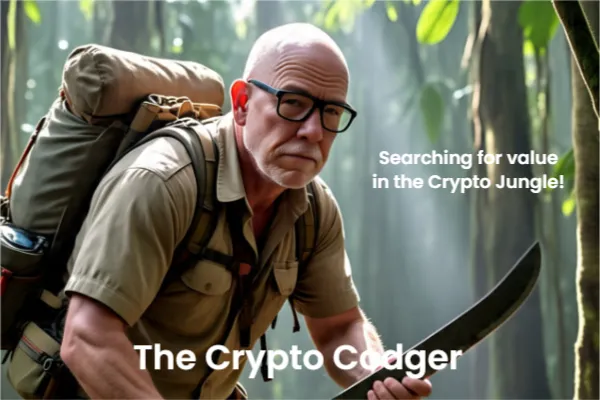
Finding Value in the Jungle
How to Find Real Value in the Crypto Jungle: A Codger's Guide
Alright, settle in. Crypto Codger here, coming to you from my perch here in North Tustin. I’m looking out over the hills, and it reminds me a lot of the crypto market: a sprawling, wild jungle. From a distance, it’s all a big green blur. But when you get closer, you see it’s teeming with life—some of it beautiful and rare, and a whole lot of it just weeds and thorny vines that’ll trip you up if you’re not careful.
Every day, my inbox is flooded with questions from folks like you. "Codger, what about this new coin?" "Is that 'Dino-Floki-Elon' token the next big thing?" Everyone's looking for a treasure map. But here's the secret: there is no map. There's only a compass and a good set of principles. Today, I’m going to share my compass with you. We’re going to talk about how to separate the rare orchids from the poison ivy. This isn't about finding the next 100x meme coin overnight; it's about finding real, lasting value.
Look Past the Hype: The "Why" Matters More Than the "Wow"
First things first, you have to tune out the noise. The crypto jungle is loud. You’ve got influencers shouting from the treetops, flashy ads everywhere, and a new "revolutionary" project launching every hour. It’s all designed to trigger your FOMO—the Fear Of Missing Out.
Your first job is to become immune to it. When you see a new project, don't ask, "How high can this go?" Ask a much simpler, more powerful question: "Why does this exist?"
What actual problem is this project trying to solve? Is it making cross-border payments cheaper and faster? Is it creating a truly decentralized and censorship-resistant way to store data? Is it enabling artists to get paid fairly for their work?
Think of it like the dot-com bubble. You had companies like Pets.com that spent millions on Super Bowl ads but had a fundamentally broken business model (selling dog food online at a loss). They were all "wow." Then you had a quiet company called Amazon that was methodically building a new type of infrastructure for commerce. It was all "why." We know who won that race. Look for the "why." If a project can't explain its purpose in a simple sentence without using a bunch of buzzwords, that's your first red flag.
Read the "Whitepaper": Your Project's Blueprint
If a project has a real "why," they'll have a blueprint explaining how they're going to build it. In crypto, this is called a whitepaper. I know, it sounds intimidating, but you don't need a Ph.D. from MIT to get the gist of it. Reading the whitepaper is the single best thing you can do to protect your money.
Here's what you’re looking for:
A Clear Problem Statement: Does the paper clearly explain the problem it’s solving, right at the beginning?
A Plausible Solution: How, exactly, will their technology solve this problem? You’re looking for logic, not magic. If it sounds like they're sprinkling fairy dust to make it work, be skeptical.
The Role of the Token (Tokenomics): This is critical. Why do they need a cryptocurrency token for this to work? If the token feels tacked on, like it’s just there for fundraising, be very wary. A good project has a token that is essential to the function of its network—it’s used for transaction fees (gas), for securing the network (staking), or for voting on changes (governance).
A Realistic Roadmap: What are the project's milestones? A roadmap that just says "Q1: Marketing, Q2: Moon, Q3: Mars" is a joke. A real roadmap details technical goals, testnet launches, and mainnet upgrades.
A good whitepaper is a sign of a serious team. A project with no whitepaper, or one that’s just a copy-paste job full of grammar errors, is a sign to run for the hills.
Follow the Team, Not Just the Token
An idea is only as good as the people building it. You wouldn't invest in a restaurant run by a chef who can't cook, right? Same principle applies here. You absolutely must investigate the project’s development team.
Look for a section on their website that lists the founders and key developers. Then, put on your detective hat.
Are They Real? Do they have LinkedIn profiles? Do they have a history of work in technology, cryptography, or finance? Anonymous teams are a massive red flag. While the founder of Bitcoin was anonymous, that was a once-in-a-generation event. For 99.9% of projects, anonymity is a cover for a potential rug pull.
What's Their Track Record? Have they built successful projects before? Or is their history littered with failed ventures?
How Do They Communicate? Are they active on platforms like Twitter or Discord? Do they host regular AMAs ("Ask Me Anything") and answer tough questions from the community? A team that is transparent and engaged is a team that has confidence in its project. A team that hides, deletes critical comments, or only talks about price is a team you can't trust.
Community and Adoption: Is Anyone Actually Using This Thing?
Finally, after all that research, you need to look for signs of life. A project can have a great idea, a brilliant whitepaper, and a rockstar team, but if nobody uses it, it’s worthless.
Don't just look at the number of followers on Twitter or members in a Telegram group. Those can be easily bought. You need to look for signs of genuine, organic adoption.
On-Chain Metrics: Use a block explorer like Etherscan to see what’s happening on the network. How many daily active wallets are there? How many transactions are being processed? Numbers don’t lie.
Developer Activity: Check out the project’s GitHub page. This is where the code is stored. You can see how many developers are contributing and how often they are pushing updates. A busy GitHub is a sign of a healthy, active project. A dusty, abandoned one is a bad omen.
Real Partnerships: Look for meaningful partnerships that will lead to actual use of the technology, not just a press release with another crypto project. Is a logistics company actually using their blockchain to track goods? Is a financial institution piloting their technology for settlements? That's real adoption.
The Codger's Final Take: Patience is Your Superpower
Finding value in the crypto jungle isn't a get-rich-quick scheme. It’s farming, not gambling. You have to be willing to do the work: to read, to research, and to think critically. You plant your seeds in fertile soil, and you tend to them with patience.
Most of the noise is just that—noise. The real value is being built quietly by dedicated teams solving real problems. Your job is to find them. So, turn down the volume, pick up your compass, and start looking for the "why."
That's the dispatch from here in North Tustin. Happy prospecting.
